
Published 15 October 2026
You have pulled up the flooring and you are staring at whatever is underneath: old plank subfloor, or plywood, sitting on top of the floor joists. The question every homeowner and renovator asks at this point is the same one: can you salvage the subfloor and joists, or does all of it go in the bin along with the flooring that came out first? Our interior demolition crews get asked this on almost every strip-out, and the honest answer splits into two separate questions, not one.
The subfloor and the joists are not the same decision. One is usually a judgment call made board by board. The other is almost always settled before the crew ever shows up. This guide walks through both, plus the sequencing choice that actually decides what a careful strip-out costs you in time.
Quick take
Floor joists almost always stay in place; they get inspected and reinforced where needed, not pulled out and reused elsewhere. Subfloor sheathing is the real salvage question, and it comes down to fastener damage, water history, and whether the boards match what your new flooring needs. Hand demolition protects salvage value; machine strip-out trades it for speed.
Can You Salvage Both the Subfloor and the Joists?
Subfloor sheathing and floor joists sit one on top of the other, but they are evaluated on completely different terms. The subfloor is a finish material choice: old fir plank or plywood that either has a second life as flooring, shelving, or backing material, or it does not. The joists are the framing that holds the whole floor up, and framing is judged on condition and capacity, not on whether the wood would look nice reused somewhere else.
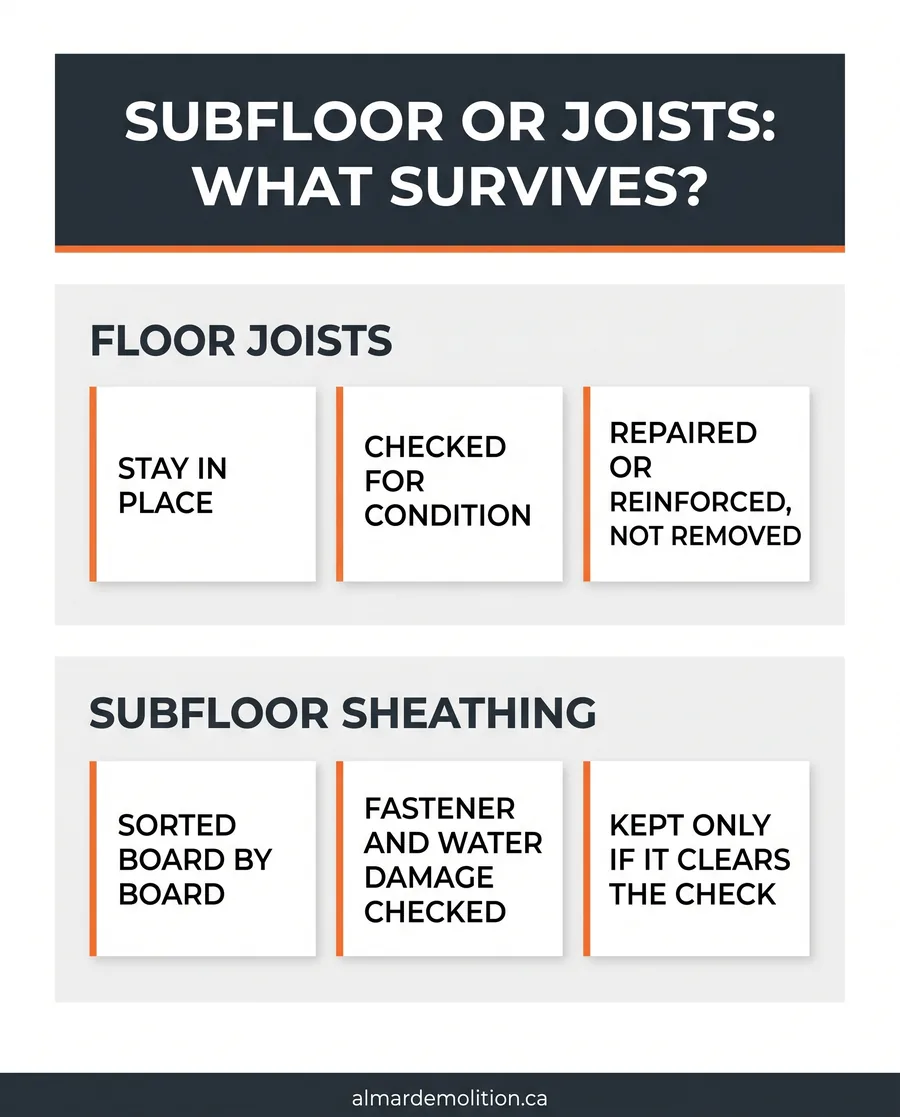
That difference is why the answer to “can you salvage subfloors and joists” is rarely a flat yes or no. It is closer to: the subfloor gets sorted board by board, and the joists get a condition check that decides whether they need anything done to them at all.
Why Floor Joists Usually Stay Right Where They Are
Whether you can salvage the subfloor and joists on a given project often gets decided right here, before removal even starts. Joists carry load in place, spanning between foundation walls or beams, and every one of them is cut and fitted to that specific span. Pulling a joist out to reuse somewhere else does not usually make sense: the piece has to be re-measured, re-cut, and re-fastened into a new span that almost certainly is not identical, and the labour to do that safely tends to cost more than a new piece of dimensional lumber. On most projects, our floor removal specialists leave the joists exactly where they are and work around them, rather than treating them as material to recover.
What does change is condition. A joist that is solid gets left alone. A joist with rot, old water damage, or an undersized notch cut for plumbing or wiring gets flagged for repair or sistering, which means fastening a new piece of lumber alongside the old one rather than replacing the whole span. Either way, the joist stays in the house. It is repaired or reinforced in place, not removed and salvaged.
What Turns Old Subfloor Into Firewood
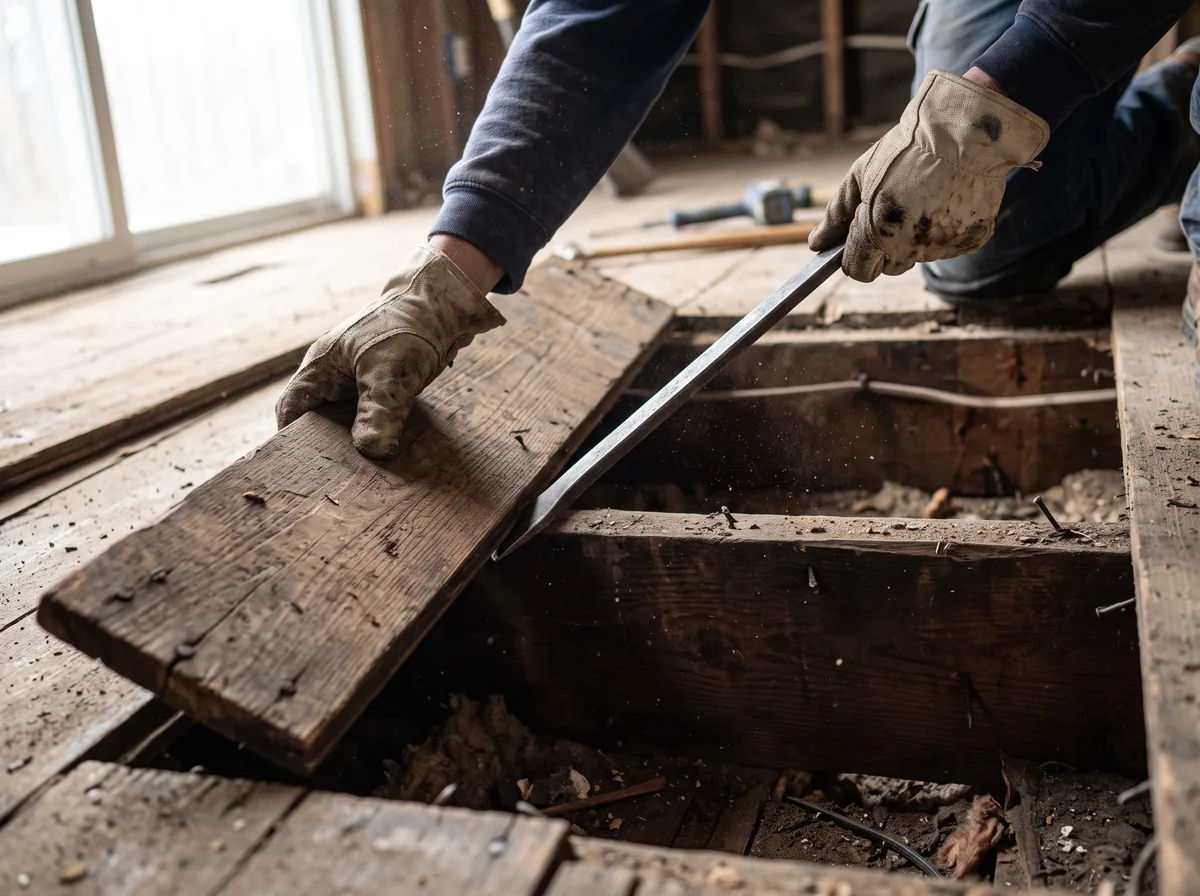
Old plank subfloor has genuine reuse value when it comes up clean: as a rustic feature wall, shelving stock, or backing material. The same boards are firewood, or at best mulch material, when any of the following show up. In an older GTA house where the subfloor sits directly over an unfinished basement, several of these show up more often than owners expect, which is one more reason our basement demolition work and interior strip-outs are usually scoped together. Working through the list below is how you actually decide what to salvage from the subfloor and joists on an older house.
- Fastener damage: Decades of nails, then screws added over the nails, leave boards split and full of embedded metal that has to be pulled or cut around before the wood is usable again.
- Water staining and cupping: A board that has cupped, warped along its length, holds that shape permanently and will not lie flat again, no matter how it gets reinstalled.
- Hidden nails and staples: Old flooring adhesive, carpet tack strip, and tile backer are commonly fastened straight through the plank, and every one of those fasteners is a hazard for whoever handles the board next.
- Finishes from the lead-paint era: Older subfloor and sub-surface boards were sometimes coated or splashed with paints that, per Health Canada’s guidance on older homes, are likely to contain lead if the house was built before 1960. That changes how the material should be handled, not whether it looks reusable.
- Thickness mismatch: Modern flooring products are often engineered around a specific subfloor thickness, and century-old plank frequently runs thicker or thinner than what a new installation calls for, even when the boards themselves are in great shape.
Red flag
Soft, spongy spots underfoot, a visible sag between joists, or a smell of damp wood are not a subfloor cosmetic problem. Stop and get the framing looked at before anyone keeps working on or around it.
Hand Demolition or Machine Strip-Out: The Real Tradeoff
Whether subfloor comes out intact enough to salvage is decided less by the wood and more by the method. Ask these three questions before the crew shows up:
- Do you actually want the material back? If nobody has a use for the old boards, there is no reason to pay for the slower, careful removal that salvage requires.
- How much of the subfloor already looks compromised? Widespread staining, soft spots, or crumbling edges usually means the salvage yield will be low no matter how carefully it comes up, which tips the decision toward speed.
- How much schedule slack does the project have? Hand demolition takes real time; machine strip-out does not. That time difference, not the material itself, is the cost driver most people underestimate.
| Criteria | Hand Demolition | Machine Strip-Out |
|---|---|---|
| Labour time | Higher – boards pried, sorted, and de-nailed one at a time | Lower – material is broken up and cleared in bulk |
| Salvage yield | Higher – boards come up largely intact | Low to none – material is shredded or broken in place |
| Debris handling | Sorted piles, staged for reuse or clean disposal | Mixed debris, bin-ready but not sortable afterward |
| Best suited for | Small areas, feature-worthy wood, or asked-for reuse | Large open floors with no reuse plan and a tight schedule |
| Crew time on site | Longer, since every board is handled individually | Shorter, since sections come out in large pieces |
How much you ultimately salvage of the subfloor and joists on a project comes down to which method the crew uses. Read that table as a spending decision, not a quality one. Machine strip-out is not careless, and hand demolition is not automatically better; they are two different trades against the same job, and the one that fits depends on whether the material underneath is worth the extra time.
What to Check Before the Crew Starts
A few minutes of checking before demolition starts decides whether you need to salvage the subfloor and joists at all, or simply clear the floor and move on:
- Confirm what is actually underneath: Plank, plywood, and particleboard sub-surfaces all salvage differently, and a quick look under a pulled-up floor register or vent usually tells you which one you have without opening the whole floor.
- Look for signs of a prior repair: A patched or replaced section of subfloor is a strong hint that something underneath already failed once.
- Note any staining, softness, or smell: Mark those areas so the crew treats them differently from the rest of the floor.
- Ask about the home’s age: In a house built before 1960, flag the lead-paint-era finish question up front rather than after boards are already stacked for reuse.
- Decide what you want: A clear answer here is what lets a contractor quote hand demolition against machine strip-out honestly, instead of defaulting to whichever is faster.
If you want to see what a careful, salvage-minded strip-out looks like on a finished job, our recent interior strip-out projects page has examples from around the GTA.
When to Stop and Get the Framing Looked At
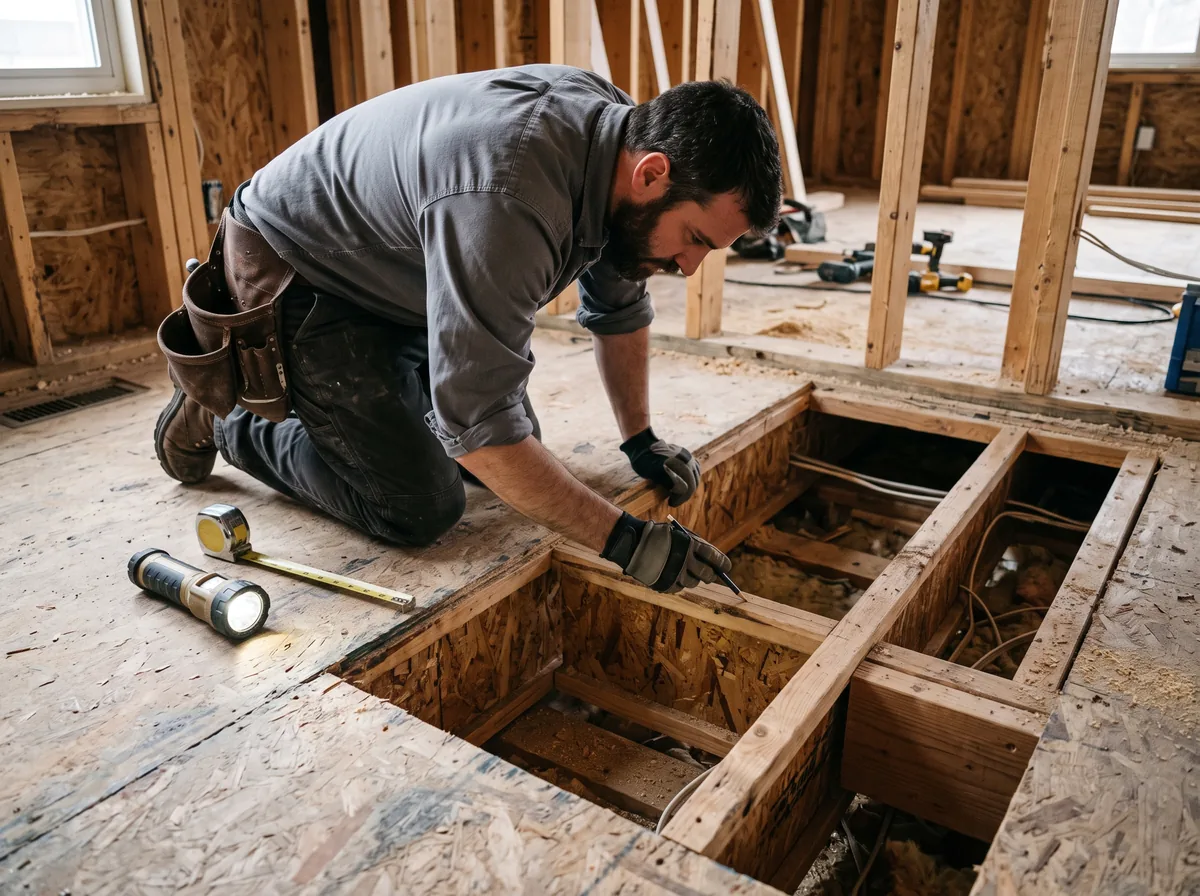
Every point above assumes the framing underneath is sound. When it is not, the subfloor salvage question stops mattering until the framing question is answered. Sagging between joists, springy or bouncy flooring that was not there before, visible rot, or a joist that has been cut or notched for plumbing or wiring beyond what looks reasonable are all reasons to pause.
This is not a call for a contractor to make alone, and it is not something a demolition crew is scoped to sign off on. Route it to your municipal building department or a qualified building professional before work continues on that section. Getting that opinion first is cheaper than discovering the answer partway through a residential demolition project.
Good to know
This article is general information for homeowners and renovators planning an interior strip-out, not a condition assessment of your specific floor. Framing capacity, code requirements, and lead-paint-era material handling depend on your building’s age and construction, and vary by municipality. Confirm framing concerns with your local building department or a qualified building professional, and confirm lead-paint handling with a qualified specialist, before removing or reusing any material. ALMAR Demolition GTA does not provide structural or engineering assessments.
Download the free quick guide
A one-page worksheet covering what to check before an interior strip-out and the questions worth asking your contractor.
Frequently Asked Questions
Is Old Subfloor Ever Worth More Than New Material?
Occasionally, when it is old-growth fir or pine in clean condition and someone specifically wants it for a feature wall or furniture stock. For a straightforward flooring replacement, new material is almost always the simpler and more predictable choice, since it comes in consistent thickness with no fastener damage to sort through.
Do Floor Joists Ever Get Replaced Instead of Repaired?
It happens, but it is decided section by section rather than as a blanket replacement. A joist with damage beyond what sistering can fix may need a full replacement piece cut to that span. That decision belongs to whoever is qualified to assess the framing, not to the demolition scope.
How Do You Know if a House Has Lead-Paint-Era Finishes?
Age is the first clue: Health Canada notes that homes built before 1960 are likely to contain lead-based paint somewhere in the structure. That is a reason to ask the question early, not a confirmation either way, and a qualified specialist can test the specific material before it is handled or reused.
Does Salvaging the Subfloor Slow Down the Whole Demolition?
Yes, and that is the tradeoff to plan for rather than be surprised by. Hand removal of boards worth keeping takes longer than clearing a floor with equipment, so a project with a tight schedule and no specific reuse plan is usually better served by machine strip-out.
Whether it makes sense to salvage the subfloor and joists on your project is the real question this whole guide is answering. The verdict: joists are a condition call, almost always resolved in place, not a salvage call. Subfloor is the real salvage question, and fastener damage, water history, lead-paint-era finishes, and thickness mismatch decide which boards clear the bar. Whether either question is even worth asking on your project comes down to one thing: do you want the material back badly enough to pay for the slower, careful method it takes to keep it.
If you are not sure which way that answer points on your floor, request a free estimate, and we will walk the space with you before anything comes up.